OpenClaw vs Claude sounds like one comparison, but it usually hides three separate questions. Are you comparing OpenClaw to the Claude app? Are you comparing it to Claude Code? Or are you really asking whether OpenClaw can use Claude models? Those are different decisions, and they lead to different answers.
If you keep that split in mind, the whole topic gets easier. OpenClaw is a self-hosted gateway for chat apps. Claude is a hosted chat product. Claude Code is Anthropic's coding tool for terminals, IDEs, desktop, and web. You can choose one, two, or all three, depending on what job you need done.
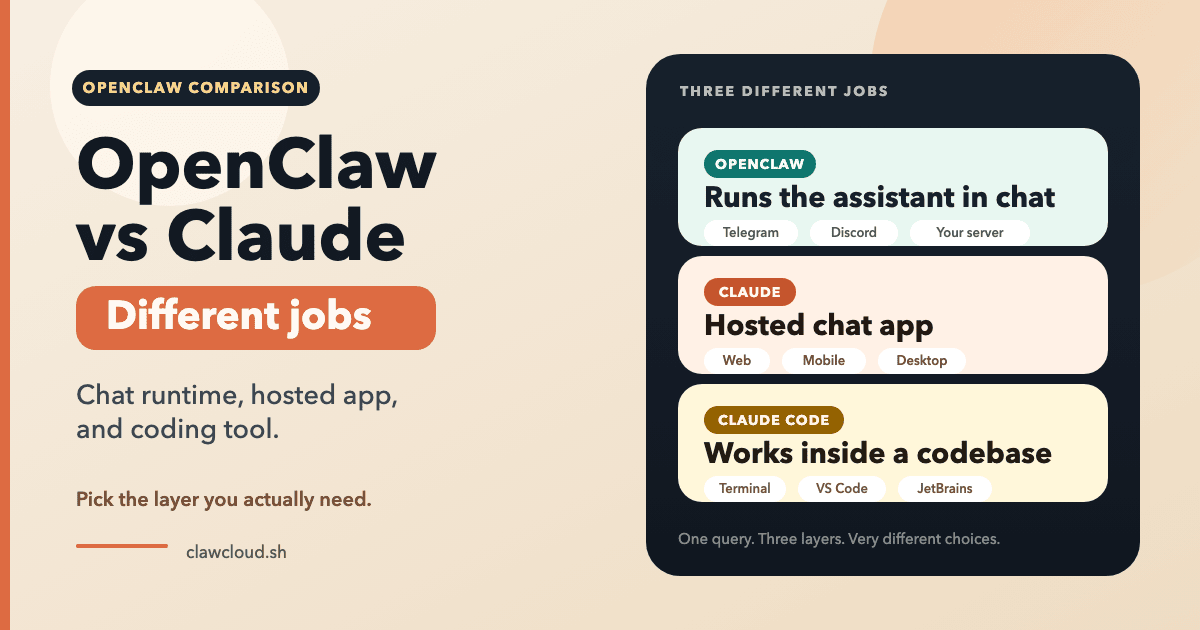
Why "OpenClaw vs Claude" is really three comparisons
This query gets messy because "Claude" is overloaded.
- Sometimes people mean the Claude web or mobile app.
- Sometimes they mean Claude Code inside a repo.
- Sometimes they mean Anthropic models like Sonnet or Opus.
OpenClaw sits in a different layer. It is the runtime that connects chat apps to an agent. Claude and Claude Code are product surfaces from Anthropic. Anthropic models can sit behind either of them, but that does not make the products equivalent.
That is why the usual "which one is better?" answer falls apart. Better for what? Messaging people from Telegram and Discord is one problem. Working inside a codebase is another. Having a general-purpose hosted chat app is another again.
What OpenClaw actually is
The official docs describe OpenClaw as a self-hosted gateway that connects chat apps like WhatsApp, Telegram, Discord, and iMessage to AI agents. You run it on your own machine or a server, and the gateway becomes the source of truth for sessions, routing, and channel connections.
That matters because OpenClaw is not built around a browser tab. It is built around an always-on assistant that lives inside chat. You can add it to a Telegram group, keep it in Discord, or run it as a personal assistant you message from your phone. That is a different product shape from Claude's hosted app.
OpenClaw also exposes model control in chat. The docs show /model as the main command for switching models, with /models as an alias. If you care about routing work between providers, that is a practical difference. You are not locked to one product surface or one model family.
There is also a plain storage story. OpenClaw memory is stored as Markdown files in the workspace, including MEMORY.md and dated files under memory/. If you care about where the bot's notes live, that is refreshingly concrete. The memory docs say the files are the source of truth.
If you want the short version, OpenClaw is best understood as a messaging-native runtime. It is not primarily a coding assistant, and it is not primarily a hosted chat app.
What Claude and Claude Code actually are
Claude the product is the easier part to explain. Anthropic presents it as a hosted chat and productivity app on web, iOS, Android, and desktop. If your goal is "I want a polished place to talk to Claude and use Anthropic features," that is the product you are evaluating.
Claude Code is different. Anthropic's docs call it an agentic coding tool that reads your codebase, edits files, runs commands, and works with development tools. The current docs and quickstart position it across terminal, VS Code, JetBrains, desktop, web, Slack, and CI/CD workflows. In the first-run flow, you open a project directory, start claude, and let it work inside that repo.
The other important distinction: Claude Code asks for permission before modifying files. Anthropic calls that out explicitly in the quickstart. That makes sense because Claude Code is designed for development work, not for acting like a bot inside your messaging apps.
So the clean split is this:
- Claude app: hosted chat and productivity surface.
- Claude Code: repo-aware coding workflow tool.
- OpenClaw: self-hosted runtime for chat-native agents.
Once you separate those roles, the comparison stops feeling blurry.
Where OpenClaw wins
OpenClaw wins when the assistant needs to live in chat.
If you want an AI assistant in Telegram, Discord, Feishu, or other messaging channels, OpenClaw is the right layer. It is designed for that job. Claude app is not trying to be your Telegram bot. Claude Code is definitely not trying to be your Telegram bot.
OpenClaw also wins when you want a persistent assistant that belongs to your own runtime instead of a hosted product account. You control the server, the routing, the channel connections, and the model selection. You can switch models in chat, keep conversations inside your own deployment, and decide how the bot behaves in groups and DMs.
This is also where OpenClaw stops being an alternative to Claude and starts being a delivery layer for Claude. If what you really want is "Claude in Telegram" or "Claude in Discord," OpenClaw is how you get there. Anthropic provides the model. OpenClaw provides the runtime and the chat surface.
That is why the broader OpenClaw vs ChatGPT, Claude, and Gemini piece only gets you part of the way. The sharper question is not model quality. It is whether you want the assistant inside a chat app you already use.
Where Claude Code wins
Claude Code wins when the assistant needs to live in your project.
If you spend most of your day in a terminal, VS Code, or JetBrains, Claude Code is closer to what you want. It is built to inspect a repo, explain files, propose edits, run commands, and help with real development tasks. You do not have to think about bot tokens, channel setup, or keeping a messaging runtime alive.
That lower friction matters. If your whole use case is "help me understand this codebase and make changes safely," Claude Code is the simpler answer. It has the right defaults, the right surfaces, and the right workflow.
OpenClaw can help with coding too, especially if you want to message an agent from chat, but that is not the same thing as having a repo-native coding assistant. Trying to force the two products into the same category usually leads to a bad buying decision.
When they are not alternatives at all
This is the part most comparison posts miss.
OpenClaw and Claude Code are often complements, not substitutes. You can use Claude Code for development work and still run OpenClaw as a persistent assistant in your chat apps. You can also run OpenClaw with Anthropic models behind it, so the same model family shows up in a different interface for a different job.
That means these common questions have pretty direct answers:
- Want a coding assistant in your repo? Pick Claude Code.
- Want a hosted chat app on web and mobile? Pick Claude.
- Want Claude-style intelligence inside Telegram or Discord? Pick OpenClaw as the runtime, then connect the model you want.
Once you frame it that way, "OpenClaw vs Claude" becomes a job-to-be-done decision instead of a vague brand comparison.
Comparison table
| Row | OpenClaw | Claude | Claude Code |
|---|---|---|---|
| Primary job | Messaging-native AI assistant runtime | Hosted chat and productivity app | Agentic coding assistant |
| Main surface | Chat apps plus Control UI | Web, mobile, and desktop app | Terminal, IDE, web, desktop, Slack, CI/CD |
| Hosting model | Self-hosted on your machine or server | Hosted product | Hosted account with local project workflow |
| Channel support | Broad chat-channel support | Not the core product shape | Not the core product shape |
| State and memory | Markdown files on disk for memory | Product-managed features | Conversation and project context for coding tasks |
| Best fit | Persistent assistant in chat | General-purpose Claude app usage | Codebase work |
Best choice by use case
If you want a clean rule of thumb, use this one.
- Pick Claude Code if you mostly want help inside a repo.
- Pick Claude if you want a hosted app on web, desktop, or mobile.
- Pick OpenClaw if you want an always-on assistant inside chat.
- Pick OpenClaw plus Claude models if you want Anthropic intelligence in Telegram or Discord.
That last option is the interesting one. It is why this comparison keeps showing up. People are not always looking for a replacement. A lot of them are looking for a bridge.
Where ClawCloud fits
If OpenClaw is the right answer but you do not want to self-host it, that is where ClawCloud fits. It gives you managed OpenClaw hosting so you can focus on the bot instead of the server work.
That is the real fork in the road for many buyers. Not "Claude or OpenClaw?" but "Do I want a hosted chat product, a coding tool, or my own assistant in chat without running the infrastructure myself?"
If you are still early in that decision, start with the getting started with OpenClaw guide, the personal AI assistant use case, and the self-hosting tradeoff post. Those three pages usually make the next step obvious.
FAQ
Is OpenClaw a Claude alternative?
Sometimes, but not in the simple head-to-head way the query suggests. OpenClaw is closer to a runtime for chat-native assistants, while Claude is a hosted app and Claude Code is a coding tool. In many setups, OpenClaw and Claude complement each other.
Can OpenClaw use Claude models?
Yes. OpenClaw is built to work with model providers, and Anthropic models can sit behind it. The point of OpenClaw is not to replace every model provider. It is to give those models a messaging-native runtime.
Does Claude Code work in Telegram or Discord?
Claude Code is not positioned as a Telegram or Discord bot runtime. Anthropic positions it around coding workflows in terminal, IDE, web, desktop, Slack, and CI/CD. If you want an assistant inside messaging apps, OpenClaw is the closer fit.
Which one is better for coding?
Claude Code. That is the cleaner answer if your main job is coding inside a project. OpenClaw can support coding-oriented agents, but its main job is running an assistant in chat, not acting as a repo-native development tool.
For the official product details behind this comparison, read the OpenClaw docs, the OpenClaw slash command reference, the Claude Code overview, the Claude Code quickstart, and the current Claude app plans.