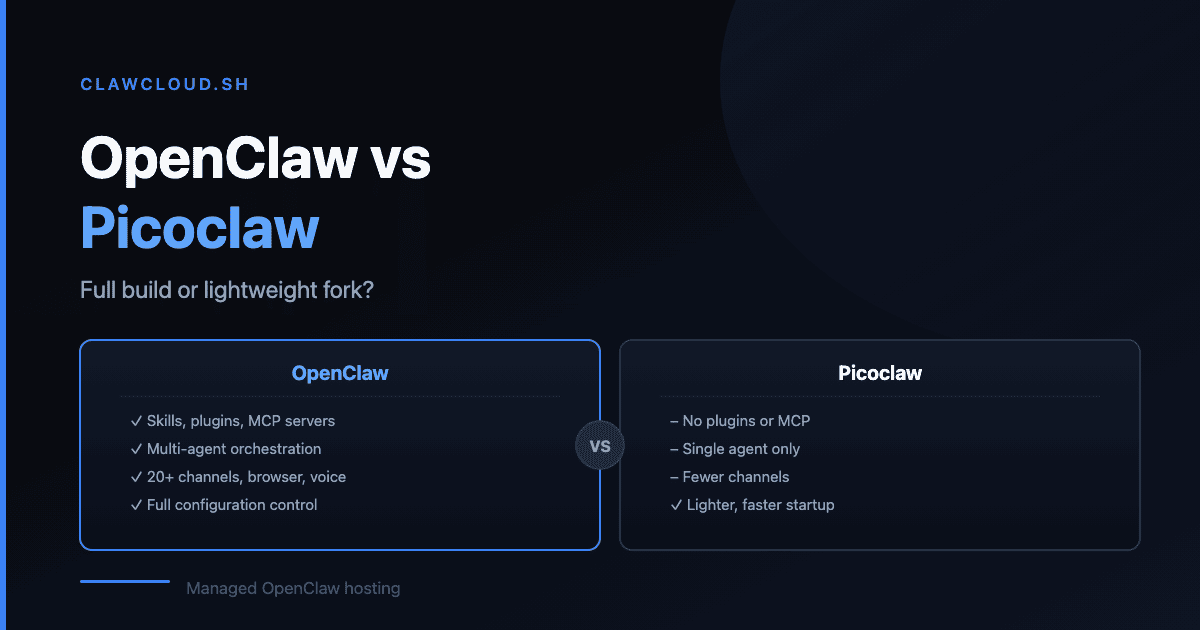
Picoclaw keeps showing up in search queries and community threads. If you've seen the name and wondered whether it's an alternative to OpenClaw or a different product entirely, here's the short answer: it's a stripped-down build of OpenClaw itself.
What Picoclaw actually is
Picoclaw is a lighter, less resource-intensive build of OpenClaw. It's not a separate project or a competitor — it's OpenClaw with features removed to reduce footprint.
A recent Show HN post from Cyqle described it as "a ready-to-run Picoclaw snapshot — a lighter, less resource-intensive build of OpenClaw with a custom wizard." That's the clearest public description available.
Think of it as OpenClaw minus the parts that need a beefy server. If standard OpenClaw is the full toolbox, Picoclaw is the travel kit.
What Picoclaw drops
The exact feature set varies by build, but the pattern is consistent: Picoclaw trims resource-heavy components to run on smaller hardware.
Features commonly reduced or removed:
- Full model switching. Standard OpenClaw supports 94 curated models across 20+ providers. Picoclaw typically locks to a smaller set or a single provider.
- Skill and plugin ecosystem. OpenClaw has ClawHub with hundreds of installable skills (
clawhub install <slug>). Picoclaw builds usually ship with a fixed skill set — no runtime installation. - Channel breadth. OpenClaw supports 21+ channels including Telegram, Discord, WhatsApp, Feishu, Slack, and more. Picoclaw often targets one or two.
- Memory and context features. OpenClaw's memory system writes notes to Markdown files and supports semantic search. Picoclaw may simplify or skip this entirely.
When Picoclaw makes sense
If your use case is narrow — one channel, one model, minimal skills — Picoclaw lets you run on cheaper hardware. A $5/mo VPS that would struggle with full OpenClaw might handle Picoclaw fine. For personal use with light traffic, the smaller footprint is a real advantage.
Picoclaw also makes sense for quick experiments. You want to see if an OpenClaw-style assistant works for your workflow before committing to the full setup.
When standard OpenClaw makes sense
If you need model switching, want to install skills from ClawHub, use multiple channels, or plan to grow beyond light personal use — you need the full build. Picoclaw's trade-off is permanent: the features it removes don't come back without switching to standard OpenClaw.
The other thing to consider: community support. Bug reports, guides, tutorials, and community discussions almost always reference standard OpenClaw. Picoclaw-specific troubleshooting resources are sparse.
Where ClawCloud fits
ClawCloud runs standard OpenClaw, not Picoclaw. Every instance gets a dedicated VM with enough resources for the full feature set — 94 models, ClawHub skills, multiple channels, memory, the works.
There's no "Picoclaw tier" on ClawCloud. If you want the lightweight experience, self-host Picoclaw. If you want the full OpenClaw with managed infrastructure, that's what ClawCloud does.
For how standard OpenClaw compares to other alternatives like NanoClaw and IronClaw, see the OpenClaw vs NanoClaw, IronClaw, and KimiClaw comparison. For getting started with full OpenClaw on ClawCloud, see the 101 guide.