If you are searching for OpenClaw alternatives, stop and pin down what you actually want replaced. Some people want OpenClaw without the server work. Some want a coding assistant inside a repo. Some want a framework for building agents from scratch. Some want a different runtime with a different security or architecture story.
That is why most alternatives posts are weak. They throw hosted services, coding tools, frameworks, and runtimes into one flat list and pretend they are interchangeable. They are not. Once you sort them by job, the decision gets much easier.
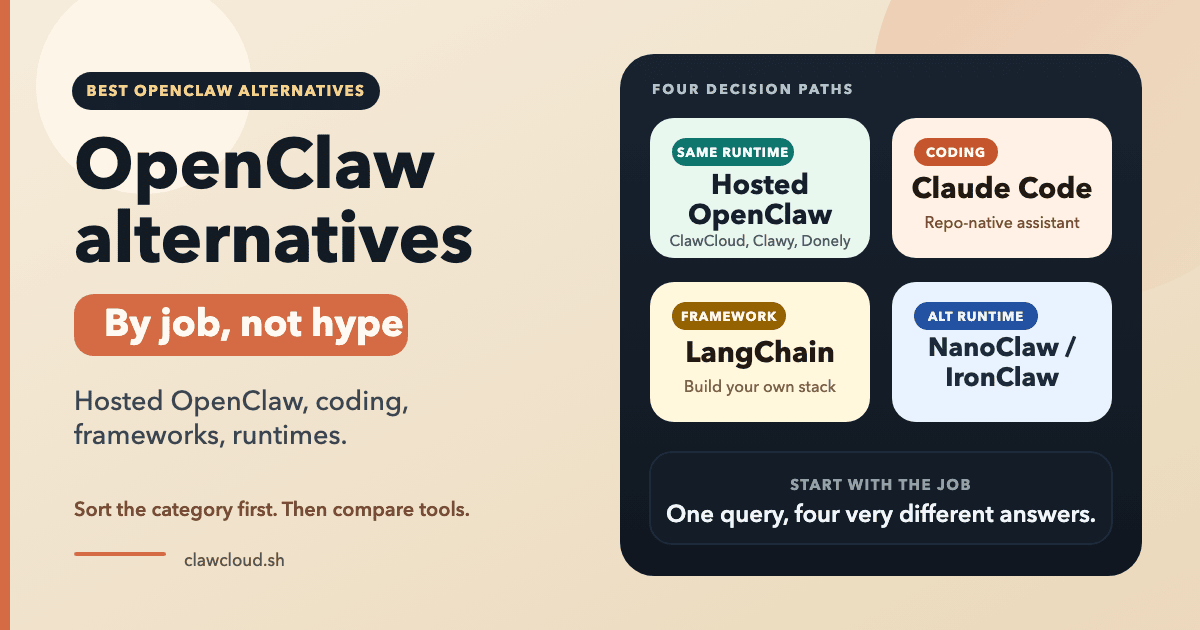
What do you actually want instead of OpenClaw?
If you are still at the "what is OpenClaw" stage, the official OpenClaw docs are clear about it: OpenClaw is a self-hosted gateway that connects chat apps to AI agents, running on your own machine or server. That already separates it from a hosted chatbot app or a repo-native coding assistant.
It also explains why queries like openclaw ai agent, claude code, and langchain show up in the same cluster even though they point in different directions. People are not always looking for one cleaner replacement. A lot of them are trying to decide which category they need.
The branches are simple:
- If you want the same OpenClaw model with less ops work, look at hosted OpenClaw services.
- If you want help inside a codebase, look at coding assistants such as Claude Code.
- If you want to build your own system, look at frameworks such as LangChain.
- If you want a different runtime philosophy, look at NanoClaw or IronClaw.
Once you make that split, the rest of the article is mostly cleanup.
If you still want OpenClaw, use hosted OpenClaw services
A surprising number of "OpenClaw alternative" searches are really asking for one thing: "Can I keep OpenClaw but stop managing the server myself?"
If that is your situation, the closest alternative is not a new runtime. It is hosted OpenClaw.
That is the point of ClawCloud vs Clawy vs Donely: OpenClaw Hosting Compared. Those products are not replacing the OpenClaw idea with something else. They are wrapping the same core runtime in different levels of hosting, control, and simplicity.
- ClawCloud fits when you still care about runtime control, server access, and room to customize later.
- Clawy fits when you want a simpler, cheaper start and you are fine with a more opinionated hosted product.
- Donely fits when your real problem is managing several bots or team access from one dashboard.
This is the first fork in the road that most listicles miss. If you still want OpenClaw's chat-native workflow, slash commands, memory on disk, and broad channel support, leaving the ecosystem entirely may be the wrong move.
That is also why the getting started with OpenClaw guide and why self-hosting OpenClaw is hard post matter here. They help you answer the real question: do you want a different tool, or do you just want less operational work?
If the answer is less operational work, hosted OpenClaw is the cleanest path.
If you want a coding assistant, Claude Code is a different category
This is where the word "alternative" gets fuzzy.
Claude Code is an agentic coding tool. Anthropic positions it around reading a codebase, editing files, running commands, and working across terminal, IDE, browser, desktop, Slack, and CI/CD surfaces. That is a development workflow product.
If your real need is repo work, Claude Code is a cleaner fit than OpenClaw. You open a project directory and stay inside the development loop. There is no bot token, no channel setup, and no always-on messaging runtime to keep alive.
That does not make Claude Code a direct replacement for OpenClaw. It wins a different job.
OpenClaw is what you use when the assistant needs to live in Telegram, Discord, Feishu, WhatsApp, or another chat surface. Claude Code is what you use when the assistant needs to live inside your repo. The full OpenClaw vs Claude comparison goes deeper on that split, but the short answer is straightforward: repo-native coding help and chat-native bot runtime are different categories.
If you keep forcing them onto one scoreboard, you will get a messy answer. If you separate coding workflow from messaging runtime, the choice becomes obvious.
If you want to build your own agent stack, LangChain is the framework path
LangChain belongs in this conversation, but for a different reason.
LangChain is a framework for building custom agents and LLM-powered applications. Its docs describe it as a way to standardize provider access and assemble tools, memory, and orchestration, with LangGraph underneath for the control-flow layer. That makes it a builder's toolkit, not a ready-made OpenClaw substitute.
If that sounds like what you want, great. It also means you are signing up for design work.
OpenClaw starts from a running agent in chat. LangChain starts from code. With LangChain, you choose how state is stored, how tools are wired, how deployments work, which channels exist, and how failures are handled. That freedom is useful when you need it. It is also extra work when you do not.
So when is LangChain the right OpenClaw alternative?
It is the right answer when you do not want "OpenClaw, but different." You want to build your own agent system from parts. Maybe your team already works in Python services. Maybe the agent is just one part of a bigger application. Maybe the messaging-bot shape is too narrow for what you are building.
If you mainly want a working assistant in chat, LangChain is usually the wrong layer. If you mainly want a programmable framework, OpenClaw is too opinionated. That is the actual trade.
If you want a different runtime, look at NanoClaw or IronClaw
This is the category that looks closest to OpenClaw on paper, so it is where people most often flatten important differences.
The clean way to think about it is this: NanoClaw and IronClaw are real alternatives when you want their specific design bets, not when you just want OpenClaw with less effort.
NanoClaw is an independent project built on the Claude Agent SDK. It is not an OpenClaw fork. Its appeal is a smaller stack, Claude Agent SDK focus, and container isolation as a core security model. That is a real point of view. It is also a narrower one.
IronClaw is a Rust reimplementation inspired by OpenClaw, not a fork. Its pitch is privacy and security through a different technical base: Rust, WASM sandboxes, and heavier default infrastructure. That will appeal to some teams. It will also be more system than many readers want to own.
Neither project is the universal "best OpenClaw alternative." They make sharper bets:
- NanoClaw is the lighter, Claude Agent SDK route.
- IronClaw is the Rust and security-first route.
- OpenClaw stays the more general multi-channel runtime with a broader public documentation path.
If you want the longer side-by-side breakdown, OpenClaw vs NanoClaw, IronClaw, and KimiClaw covers that narrower comparison in more detail. This article is trying to answer the higher-level decision first.
Decision table
| Row | Hosted OpenClaw services | Claude Code | LangChain | NanoClaw | IronClaw |
|---|---|---|---|---|---|
| Category | Hosted OpenClaw | Coding assistant | Framework | Alternative runtime | Alternative runtime |
| Main surface | Web dashboard plus bot runtime | Terminal, IDE, browser, desktop | Code library and orchestration framework | Runtime | Runtime |
| Self-hosted? | Service-managed | Local workflow plus hosted account | You build and deploy it | Yes | Yes |
| Best for | People who still want OpenClaw without the ops work | Repo-native development work | Custom agent systems | Smaller Claude Agent SDK runtime | Rust-first privacy and security path |
| Main caution | Still the same OpenClaw ecosystem | Not a chat-bot runtime | Not a ready-made bot runtime | Smaller ecosystem and Claude Agent SDK assumptions | Heavier stack and active feature-parity tradeoffs |
Only the first column answers "I still want OpenClaw." The other columns change categories.
What not to count as a serious OpenClaw alternative yet
This part matters because trend data is noisy.
KimiClaw should not be treated as a real competitor. It is not an established project that deserves equal weight beside OpenClaw, Claude Code, LangChain, NanoClaw, or IronClaw.
I would use the same caution for names like Hermes Agent, OpenFang, Trustclaw, and ZeroClaw unless you do a same-day pass on official docs or repos before publish. They may become worth tracking. Right now they are watchlist names, not core recommendations.
Manus sits in a similar bucket for this specific article. It may deserve separate research. It does not belong in the main recommendation set here unless you verify it carefully the day you publish.
That is the trap with alternatives content. A longer list does not make the advice better. Cleaner categories do.
The short answer
If you still want OpenClaw, use hosted OpenClaw.
If you want a coding assistant, use Claude Code.
If you want to build your own agent system, use LangChain.
If you want a different runtime philosophy, look at NanoClaw or IronClaw and be honest about the trade you are making.
That answer is less flashy than a top-ten roundup. It is also more useful.
If this article confirms that you still want OpenClaw, just not the maintenance, ClawCloud is the path that keeps the runtime model while removing most of the setup burden. If it confirms that you actually want a different category altogether, that is useful too. Better to notice that before a week of setup.
FAQ
What is the closest alternative to OpenClaw?
If you like OpenClaw itself and mainly want less operational work, hosted OpenClaw services are the closest answer. That keeps the runtime model you already want instead of forcing you into a different category.
Is NanoClaw a fork of OpenClaw?
No. NanoClaw is an independent project built on the Claude Agent SDK. It is better described as a lightweight alternative with its own design choices, not as an OpenClaw fork.
Is IronClaw production-ready?
It is more honest to describe IronClaw as an early-stage runtime with a distinct Rust and security-first direction than as a drop-in OpenClaw replacement. Whether it is production-ready for you depends on how comfortable you are with its stack and current feature tradeoffs.
Is LangChain an OpenClaw alternative or a framework?
LangChain is a framework. It belongs in this conversation because some people searching for an OpenClaw alternative really want to build a custom agent system. If you want a working messaging runtime out of the box, it is the wrong layer.