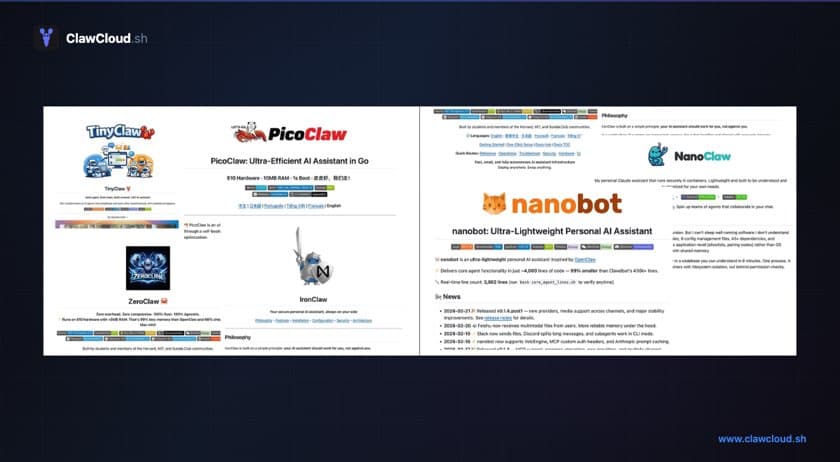
The landscape of OpenClaw alternatives
OpenClaw has been around long enough that other projects have appeared with similar goals. Some are reimplementations in different languages. Some are stripped-down alternatives with different design priorities. And some are just search terms that don't correspond to anything real.
Here's what each one actually is, based on their GitHub repos and documentation.
NanoClaw
NanoClaw (16k+ stars) is a lightweight TypeScript project that describes itself as "a lightweight alternative to Clawdbot / OpenClaw that runs in containers for security." It is not a fork of OpenClaw. It's an independent project built on the Claude Agent SDK.
What it does well:
- Container isolation by default. Agents run inside Linux containers (Apple Container on macOS, Docker elsewhere), not just behind application-level permission checks. If security through OS-level sandboxing matters to you, this is NanoClaw's main selling point.
- Small codebase. The creators explicitly prioritize code you can read and understand end-to-end. The philosophy is "modify the code instead of adding config."
- WhatsApp support was a first-class channel from day one.
Where it differs from OpenClaw:
- NanoClaw uses Claude Code skills for customization instead of a plugin or skill registry. You run
/add-telegramand Claude Code rewrites the source code of your fork. There's no equivalent of ClawHub. - Tied to Anthropic's Claude. OpenClaw supports 20+ model providers natively (Anthropic, OpenAI, Google, DeepSeek, Qwen, xAI, Mistral, Ollama, and more). NanoClaw runs on the Claude Agent SDK, which means Claude is the model.
- No multi-model switching. OpenClaw lets you switch between 100+ curated models mid-conversation with
/model. NanoClaw runs one model. - Requires Claude Code installed locally. OpenClaw is a standalone Node.js process.
When NanoClaw makes sense: You want a minimal AI assistant with strong container isolation, you're fine with Claude only, and you prefer modifying source code over configuring a system.
IronClaw
IronClaw (3.9k stars) by NEAR AI is a Rust reimplementation inspired by OpenClaw. It focuses on privacy and security with a different technical foundation.
What it does well:
- Written in Rust. Single binary, native performance, no Node.js runtime dependency.
- WASM sandbox for tools. Untrusted tools run in isolated WebAssembly containers with capability-based permissions, endpoint allowlisting, and credential leak detection.
- PostgreSQL with pgvector for persistence. Production-grade storage compared to OpenClaw's file-based approach or NanoClaw's SQLite.
- Web gateway with a browser UI for chat, memory, jobs, and logs.
Where it differs from OpenClaw:
- Early-stage. Version 0.12.0 as of late February 2026. The project maintains a feature parity tracking document against OpenClaw, which means there are gaps.
- Heavier infrastructure requirements. IronClaw needs Rust 1.85+, PostgreSQL 15+ with pgvector, and NEAR AI authentication by default. OpenClaw needs Node.js.
- Smaller ecosystem. OpenClaw has ClawHub for skills, a large user community, and extensive documentation. IronClaw's ecosystem is still forming (38 contributors vs OpenClaw's much larger contributor base).
- NEAR AI authentication by default, though it supports OpenRouter and other OpenAI-compatible endpoints as alternatives.
When IronClaw makes sense: You value Rust's memory safety guarantees, want WASM-level tool sandboxing, or already use NEAR AI's infrastructure.
KimiClaw
"KimiClaw" shows up as a rising search query (+50%), but it is not a real project. A GitHub search for "kimiclaw" returns 33 repositories, all personal projects with zero stars. There is no official organization, no website, and no community behind the name.
The search interest likely comes from people combining "Kimi" (Moonshot AI's chat model, popular in China) with "Claw" (from the OpenClaw ecosystem). If you're looking to use Kimi's models with an AI assistant, OpenClaw supports them natively through OpenRouter or by configuring Moonshot as a custom provider. See the model providers documentation for setup details.
Quick comparison
| OpenClaw | NanoClaw | IronClaw | |
|---|---|---|---|
| Language | TypeScript | TypeScript | Rust |
| Models | 20+ providers, 100+ curated on ClawCloud | Claude only | NEAR AI default, OpenRouter available |
| Channels | Telegram, Discord, WhatsApp, Slack, Signal | WhatsApp, Telegram, Discord, Slack, Signal | REPL, HTTP, Telegram, Slack, Web |
| Security model | Application-level (allowlists, pairing) | OS-level (Linux containers) | WASM sandbox + policy engine |
| Memory | Markdown files + vector search | Per-group CLAUDE.md in containers | PostgreSQL + hybrid search |
| Config | openclaw.json + skills + plugins | Modify source code | Database + .env |
| Stars | 100k+ | 16k+ | 3.9k |
| Setup | npm install -g openclaw | Clone + Claude Code /setup | cargo build or installer |
Where ClawCloud fits
If you're comparing these options, you're likely weighing how much effort you want to spend on setup and maintenance versus what capabilities you get.
ClawCloud removes the setup question for OpenClaw entirely. You get a dedicated VM with OpenClaw pre-configured, skills and memory working out of the box, access to 94 models via OpenRouter, and a dashboard for monitoring. The server is provisioned in under a minute.
NanoClaw and IronClaw are both self-hosted. There's no managed hosting option for either. If you go with either, you're running your own infrastructure.
For the full model catalog available on ClawCloud, see OpenClaw Models. For getting started, see the 101 guide.